
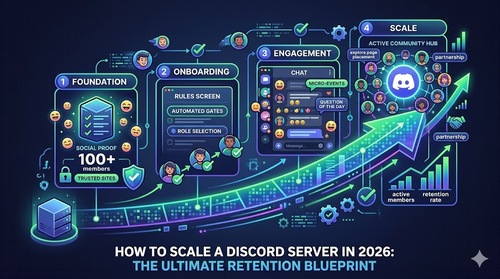
Growing a Discord server in 2026 is no longer just about getting people through the door—it’s about what happens the moment they arrive. With over 19 million active servers on the platform, the “Ghost Town Effect” is the #1 killer of new communities. If a user joins and sees a silent general chat or a member count in the single digits, they will leave within seconds.
To build a community that lasts, you need to master the transition from a “new server” to an “established hub.” This guide breaks down the 2026 framework for retention and organic discovery.
1. The Psychology of the “Lived-In” Server
Before you spend a single minute on external promotion, your server must pass the “Social Proof Test.” In community psychology, users are 80% more likely to participate in a conversation if they perceive the environment is already active and populated.
This is the “Cold Start” problem. Many successful server owners solve this by ensuring their server looks established before their main marketing push. Whether you are migrating a community from another platform or starting fresh, having a base layer of members is vital to stop “bounce rates.”
Expert Tip: If you are currently in the foundation phase, it is often helpful to use professional growth services to establish that initial credibility. For those looking to bridge the gap safely, check out our analyzed list of the best sites to buy Discord members in 2026 to ensure your growth looks natural and adheres to safety protocols.
2. Setting Up a 2026 Onboarding Funnel
In 2026, Discord’s built-in onboarding features are your best friend. A “dead” server often feels that way because new members don’t know where to go.
- The 5-Channel Rule: Don’t overwhelm users. Start with a maximum of 5-8 core channels. Too many empty channels make a server look inactive.
- Role-Selection: Use “Onboarding Tasks” to let users self-assign roles. This gives them an immediate sense of “investment” in the community.
- Automated Verification: Implement a verification gate (like a “React to Rules” bot). This not only stops spam but acts as a psychological “handshake” between the user and the community.
3. Mastering the “Member-to-Activity” Ratio
Discord’s internal discovery algorithms (and “Explore” page) don’t just look at how many people are in your server—they look at the Activity-to-Total ratio.
To keep this ratio healthy:
- Host “Micro-Events”: Weekly trivia or “Question of the Day” bots keep the chat moving even during slow hours.
- Use Drip-Feed Growth: Avoid sudden “bot spikes.” Whether you are growing organically or through service providers, ensure members join gradually over days, not minutes. This keeps your server’s growth curve looking organic to Discord’s monitoring systems.
4. Advanced Anti-Spam Protocols
As AI-driven spam bots become more common in 2026, your server’s security is a retention tool. Users will leave if they are constantly DM-scammed.
- Verification Levels: Set your server to “Medium” or “High” verification, requiring a verified phone or email.
- AutoMod Keywords: Use Discord’s native AutoMod to block common “crypto-scam” or “free Nitro” keywords immediately.
Final Thoughts
Scaling a Discord server is a marathon. By focusing on Social Proof first and Engagement Mechanics second, you create an environment where organic users feel comfortable staying for the long haul. Establish your foundation, secure your channels, and the growth will follow.
